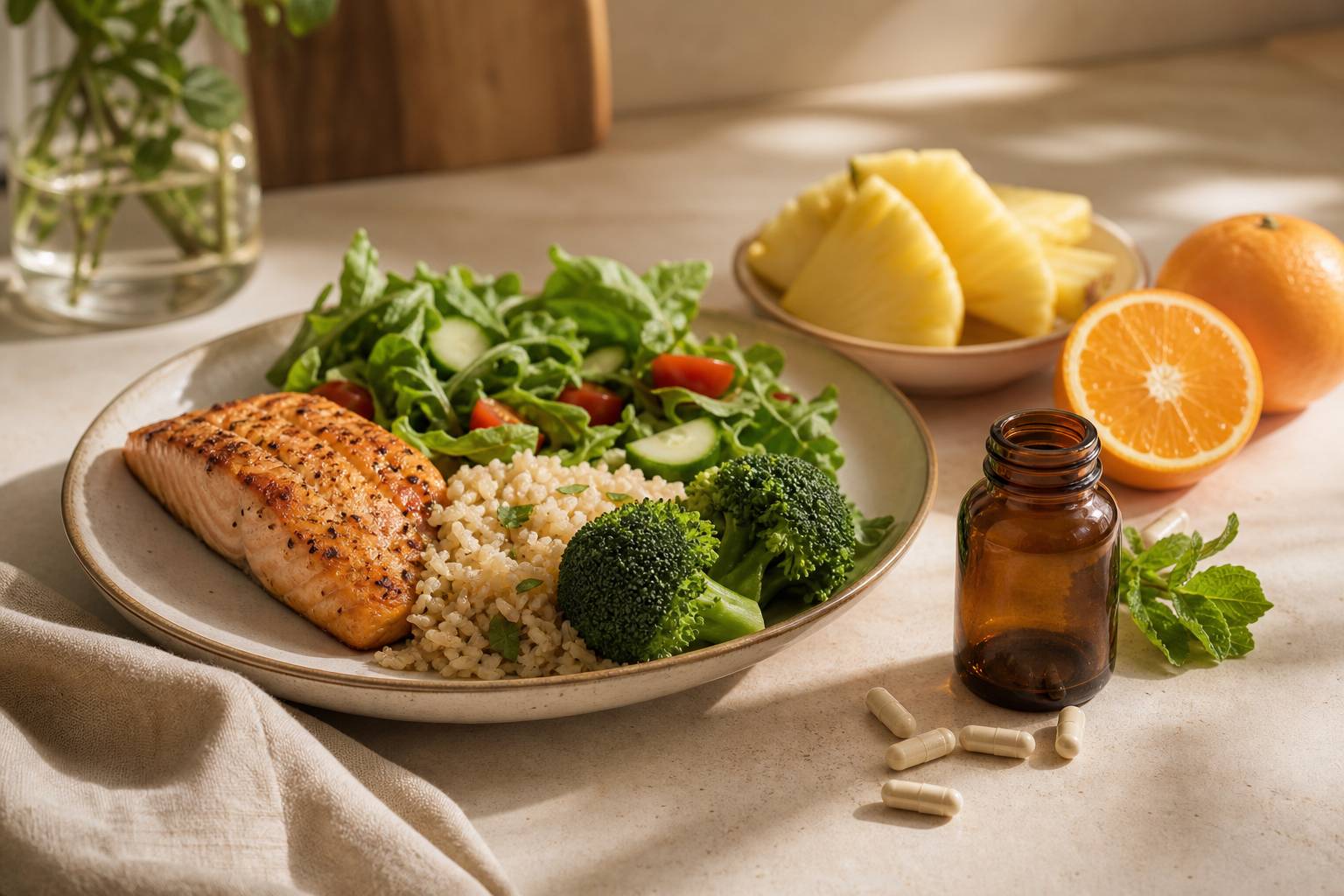
The Basics
|
|
| What it is |
Supplemental proteins (proteases, lipases, amylases) that catalyze the breakdown of food into absorbable nutrients |
| Primary use |
Reduce bloating, gas, and digestive discomfort while improving nutrient absorption from food |
| Evidence level |
Moderate — well-studied for pancreatic insufficiency and specific conditions; growing evidence for general digestive support |
| Safety profile |
Very Safe — naturally occurring proteins with minimal side effects when used appropriately |
| Best for |
Adults 40+, high-protein dieters, those with IBS/IBD, chronic bloating, or low stomach acid |
Key Facts at a Glance
- Pancreatic enzyme production declines significantly after age 40, reducing digestive efficiency
- Bloating and gas are often caused by undigested food fermenting in the colon — enzymes reduce this
- Must be taken WITH meals (not on empty stomach) to be effective
- Full-spectrum formulas include proteases, lipases, amylases, lactase, and cellulase
- Most people who need them notice improvement within the first week of consistent use
You can eat a perfectly optimized diet and still feel sluggish, bloated, and undernourished — if your digestive system isn't breaking that food down properly. Nutrient absorption isn't just about what you eat. It's about what you actually digest. And digestion depends heavily on enzymes.
What Are Digestive Enzymes?
Digestive enzymes are proteins produced by your salivary glands, stomach, pancreas, and small intestine that catalyze the breakdown of food into absorbable components. Without them, even the highest-quality food stays locked in forms your cells can't use.
The major enzyme classes:
- Proteases: Break down proteins into amino acids and peptides. Essential for absorbing the building blocks of muscle, neurotransmitters, hormones, and immune cells.
- Lipases: Break down dietary fats into fatty acids and glycerol for absorption. Required for the uptake of fat-soluble vitamins A, D, E, and K.
- Amylases: Break down starches and complex carbohydrates into simple sugars. Produced in saliva and by the pancreas.
- Cellulase: Breaks down cellulose (plant fiber). Humans don't produce this — it must come from food, gut bacteria, or supplementation.
- Lactase: Specifically breaks down lactose (milk sugar). Declines with age in many people, leading to lactose intolerance.
Signs Your Digestion May Need Support
The body has a remarkable capacity for digestion, but there are clear signals it's struggling:
- Bloating after meals — particularly after protein or fat-heavy foods
- Excessive gas — often caused by undigested food fermenting in the colon
- Undigested food in stool — a direct sign of incomplete breakdown
- Low energy after eating — food that isn't absorbed can't fuel your cells
- Heavy, uncomfortable feeling post-meal — sometimes described as food "sitting like a rock"
- Acid reflux or heartburn — often a sign of low stomach acid and impaired enzyme activity
Why Enzyme Production Declines
Digestive enzyme output isn't fixed. Multiple factors reduce it:
Age: Pancreatic enzyme output decreases significantly with age, starting as early as your 40s. This is one reason many older adults have more digestive complaints despite eating the same foods they always have.
Chronic stress: The gut is deeply connected to the nervous system. Chronic stress activates the sympathetic ("fight or flight") response, which suppresses digestive function — including enzyme secretion. Eating under stress means eating with compromised digestion.
Gut conditions: IBD, IBS, celiac disease, and other conditions damage intestinal tissue and impair enzyme production and secretion.
Low stomach acid (hypochlorhydria): Stomach acid is needed to activate pepsin (a protease) and trigger the release of pancreatic enzymes into the small intestine. When stomach acid is low — due to age, medications like PPIs, or stress — the enzyme cascade downstream is also compromised.
High-protein diets: Significantly increased protein intake increases proteolytic demand. People eating 150g+ of protein per day may outpace their natural enzyme production.
Benefits of Enzyme Supplementation
Improved nutrient absorption. The primary goal — getting more of the nutrients from the food you're eating into circulation. This matters for protein, fat, fat-soluble vitamins, and micronutrients.
Reduced bloating and gas. When food is properly broken down in the small intestine, less arrives undigested in the colon where bacteria ferment it (producing gas). This is often the fastest and most noticeable benefit.
Reduced post-meal fatigue. Improperly digested food creates an inflammatory burden. Better digestion means your body spends less energy managing that burden.
Support for gut healing. By reducing the load of undigested food reaching the lower gut, enzymes can reduce irritation and allow inflamed tissue to recover.
When and How to Take Them
Timing is critical: Digestive enzymes must be taken with meals — ideally at the start of eating. Taking them on an empty stomach means they have nothing to work on and may be inactivated before food arrives.
Full-spectrum formulas covering proteases, lipases, amylases, and additional enzymes like lactase and cellulase provide the broadest support. Look for products that specify enzyme activity levels in standardized units (FCC units), not just milligrams.
Advanced Digestive Enzyme formulas from reputable brands like Thorne include a comprehensive enzyme blend — protease, amylase, lipase, cellulase, and lactase — selected for activity levels, stability across the pH range of digestion, and manufacturing quality.
Who Benefits Most?
- Adults over 40 with declining natural enzyme output
- High-protein dieters whose demand exceeds natural production
- People with IBS, IBD, or celiac disease
- Anyone with chronic bloating, gas, or post-meal discomfort
- People with low stomach acid or on acid-reducing medications
Digestive enzymes are safe, non-habit-forming, and well-tolerated by most people. They're one of the more immediately noticeable supplements — most people who need them feel a meaningful difference within the first week of consistent use.
Your food is only as good as your ability to absorb it. Digestive enzymes bridge that gap.
What the Experts Say
Opinions below are paraphrased from each expert's public work, interviews, and podcasts — not direct quotes.
Paul Saladino
Paul Saladino has a nuanced stance on digestive enzymes, noting that carnivore-aligned eating (eliminating plant toxins and fiber that disrupt gut function) often resolves digestive issues without supplemental enzymes. He views chronically poor digestion as a signal to address diet rather than supplement around the problem.
Dave Asprey
Dave Asprey has discussed digestive enzymes within the Bulletproof framework, recommending them for those with impaired digestion, HCl insufficiency, or when consuming foods outside of one's usual pattern. He views optimizing digestion as upstream of nutrient absorption — the best diet is only as good as one's ability to absorb it.
Sources & Further Reading
- Pancreatic Enzyme Replacement Therapy in Pancreatic Insufficiency — National Institutes of Health, National Center for Biotechnology Information — https://www.ncbi.nlm.nih.gov/pmc/articles/PMC6013626/
- Digestive Enzyme Supplementation in Gastrointestinal Diseases — Current Drug Metabolism (peer-reviewed journal) — https://pubmed.ncbi.nlm.nih.gov/26806042/
- The Role of Enzyme Supplementation in Digestive Disorders — World Journal of Gastroenterology — https://www.ncbi.nlm.nih.gov/pmc/articles/PMC3099351/
- Age-Related Changes in Digestive Enzyme Production — The American Journal of Clinical Nutrition — https://pubmed.ncbi.nlm.nih.gov/11880549/
- Efficacy of Enzyme Supplementation After Dietary Fat Restriction — Digestive Diseases and Sciences — https://pubmed.ncbi.nlm.nih.gov/20824501/
Where to Buy / Find This