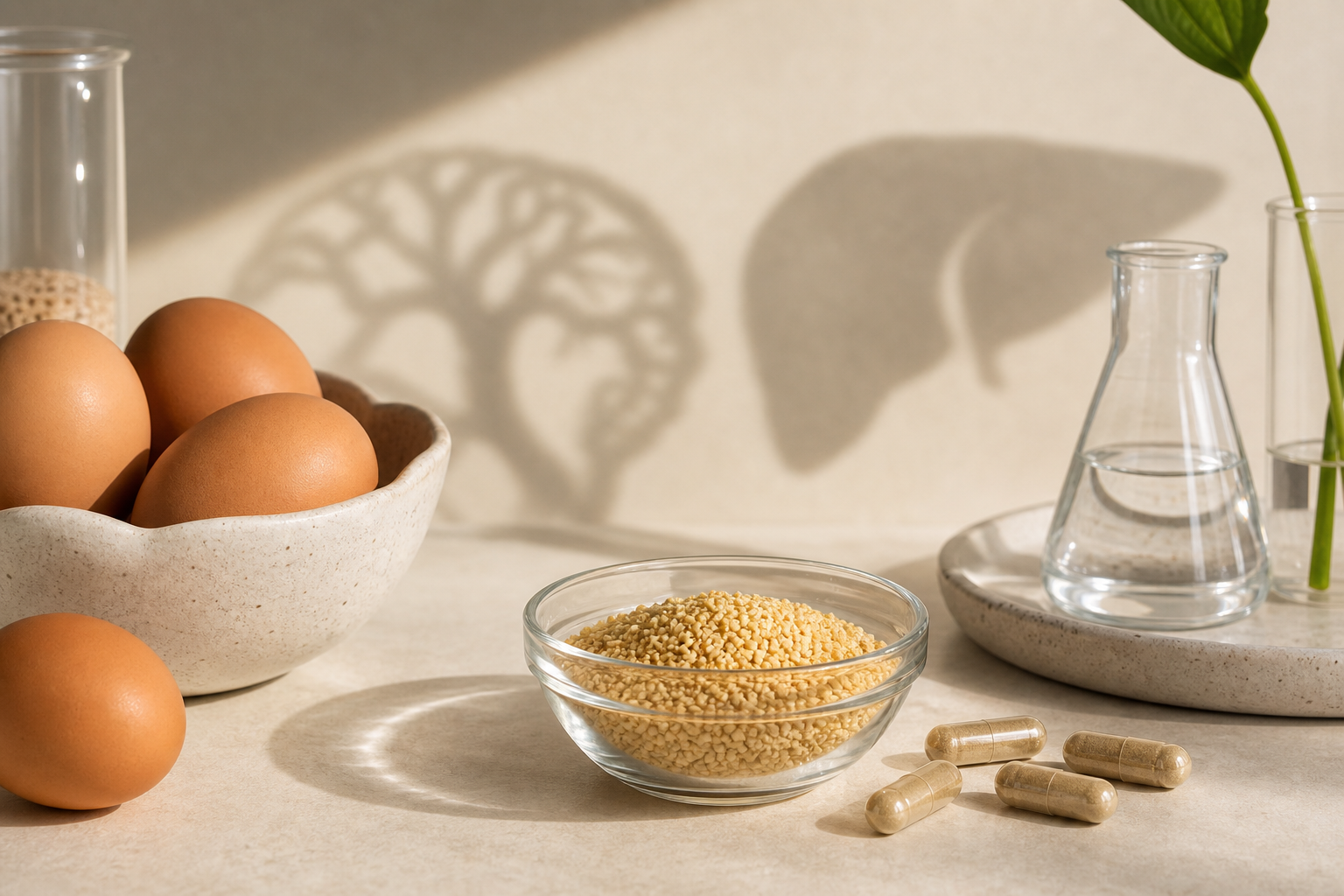
Choline is one of the least-discussed essential nutrients in mainstream health circles, despite having a well-established role in brain function, liver health, and cellular structure. Classified as an essential nutrient by the Institute of Medicine in 1998, choline is required for processes that underpin cognition, methylation, and lipid metabolism — yet surveys consistently find that the majority of Americans consume less than the Adequate Intake (AI) levels. The deficiency is largely invisible because its effects are subtle and long-term, but the consequences accumulate.
What Choline Is and Does
Choline is a water-soluble compound — not quite a vitamin, not quite an amino acid — that the body can synthesize in small amounts via the PEMT (phosphatidylethanolamine N-methyltransferase) pathway, primarily in the liver. Endogenous synthesis is insufficient for most people under most conditions, making dietary and supplemental intake necessary.
Choline's primary roles:
Acetylcholine synthesis: Choline is the direct precursor to acetylcholine, the neurotransmitter central to memory, attention, and muscle control. The cholinergic system's role in learning and memory is well-established — Alzheimer's disease involves significant cholinergic neuron loss, which is why cholinesterase inhibitors (which slow acetylcholine breakdown) are the primary pharmacological treatment. Adequate choline intake supports the substrate for this system.
Phosphatidylcholine: The most abundant phospholipid in cell membranes, phosphatidylcholine (PC) is structurally critical for membrane integrity and fluidity across every cell type. PC is particularly concentrated in brain cell membranes and in myelin sheaths. It also forms the primary lipid component of VLDL particles produced by the liver for lipid transport.
Methyl donation: Choline is a methyl donor in the one-carbon metabolism cycle, contributing to DNA methylation, gene expression regulation, and homocysteine metabolism alongside folate, B12, and betaine. Choline deficiency impairs methylation capacity.
Liver function: Choline is essential for hepatic fat export via VLDL. Choline deficiency is one of the most reliable dietary methods to induce non-alcoholic fatty liver disease (NAFLD) in animal models, and human studies confirm that inadequate choline intake is associated with liver fat accumulation and elevated liver enzymes.
Deficiency: Who's at Risk
Adequate Intake levels are 425mg/day for women and 550mg/day for men. Studies suggest 90%+ of Americans fall short. High-risk groups:
- Pregnant women: Choline demand increases substantially during pregnancy for fetal brain development and neural tube formation. Choline is the rate-limiting nutrient for fetal hippocampal development in ways that affect cognitive function long after birth. AI during pregnancy is 450mg/day, yet the majority of pregnant women consume less than 300mg.
- People with low egg intake: Egg yolks are the richest common dietary source (~150mg per yolk). Vegan and low-egg diets dramatically increase deficiency risk.
- PEMT variant carriers: A common polymorphism in the PEMT gene (present in ~50% of the population) reduces endogenous synthesis capacity, increasing dietary requirement.
- High-alcohol consumers: Alcohol depletes choline and impairs PEMT function.
Dietary Sources and Supplementation
Best dietary sources: egg yolks (150mg/yolk), beef liver (356mg/3oz), salmon (187mg/3oz), chicken liver, cruciferous vegetables (modest amounts).
Supplement forms vary significantly in bioavailability and effect:
- Phosphatidylcholine (PC): The most bioavailable form for both liver and membrane support; well-tolerated. Derived from sunflower or soy lecithin.
- Alpha-GPC (alpha-glycerophosphocholine): Highest brain bioavailability; crosses the blood-brain barrier efficiently; preferred for cognitive and acetylcholine-focused goals. Doses of 300–600mg daily are used in research.
- CDP-choline (citicoline): Also crosses the blood-brain barrier; has the added benefit of donating cytidine (a uridine precursor) alongside choline. Used at 250–500mg daily.
- Choline bitartrate: Less bioavailable than the above; cheaper but less effective for neurological applications.
For general intake adequacy, PC from lecithin is efficient and well-tolerated. For cognitive enhancement goals, Alpha-GPC or CDP-choline are the more targeted choices. Taking fish oil alongside choline-containing supplements is common, as both support membrane phospholipid composition.