SupplementsMarch 1, 20256 min read
Creatine: The Most Researched Supplement You're Probably Not Taking
Creatine is backed by decades of research and has benefits that extend well beyond athletic performance. Here's what you need to know.
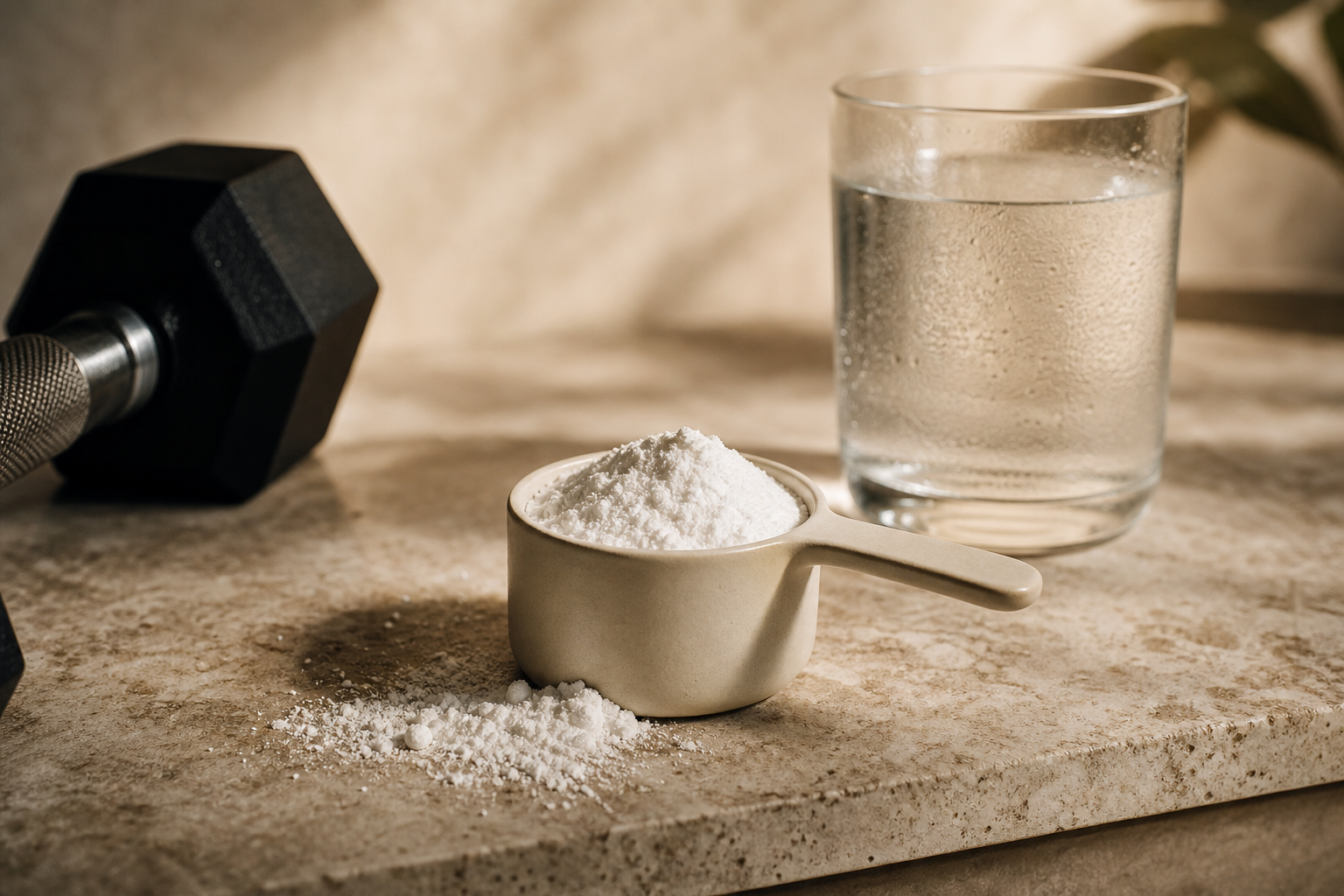
Creatine is backed by decades of research and has benefits that extend well beyond athletic performance. Here's what you need to know.
| What it is | An organic compound naturally produced in the body that helps regenerate ATP for cellular energy |
| Primary use | Increasing muscle strength, power output, and athletic performance; emerging benefits for cognition and aging |
| Evidence level | Strong — over 500 peer-reviewed studies with consistent results across populations |
| Safety profile | Very Safe — three decades of research confirm safety at standard doses in healthy individuals |
| Best for | Athletes, those doing resistance training, aging adults preserving muscle mass, vegetarians, anyone seeking cognitive benefits |
Key Facts at a Glance
Creatine is the most studied sports supplement in history, with over 500 peer-reviewed studies and a safety record that spans three decades. It's also one of the most misunderstood — still associated by many with bodybuilders and gym culture, despite having clinically relevant benefits for cognition, aging, and general health.
Creatine phosphate serves as a rapid phosphate donor for ATP regeneration in cells — particularly relevant in high-intensity, short-duration efforts (sprinting, lifting, explosive movements). By increasing the pool of available creatine phosphate, supplementation allows for:
This translates into real performance gains: meta-analyses consistently show 5–15% improvements in strength and power output with creatine supplementation versus placebo.
The research on creatine has expanded significantly into non-athletic applications:
Cognitive function: The brain uses ATP at high rates. Studies show creatine supplementation improves performance on cognitive tasks requiring short-term memory and reasoning, particularly under conditions of sleep deprivation or mental fatigue. Effects are most pronounced in vegetarians (who have lower baseline creatine levels from diet).
Aging and muscle preservation: Age-related muscle loss (sarcopenia) is one of the strongest predictors of mortality and functional decline in older adults. Creatine, particularly when combined with resistance training, helps preserve and build muscle mass in aging populations. Several trials show significant benefits in those over 55.
Depression: Emerging research suggests creatine may have antidepressant effects, possibly through mechanisms involving brain energy metabolism. A 2023 trial found that creatine augmentation of antidepressants produced significantly faster responses in women with treatment-resistant depression.
Bone density: Some evidence suggests creatine combined with resistance training improves bone mineral density markers, though the effect size is modest.
Creatine is not a fat burner. It does not directly build muscle without training stimulus. It will cause an initial increase in water retention (creatine pulls water into muscle cells) of 1–3kg, which some people misinterpret as "bloat" — this is intracellular and is part of the mechanism of action.
Creatine is not a steroid and has no hormonal effects.
Loading phase (optional): 20g/day in divided doses (4 × 5g) for 5–7 days to saturate muscle creatine stores faster.
Maintenance: 3–5g/day is sufficient for ongoing benefit. Loading simply speeds up the time to reach full saturation — the endpoint is the same.
Form: Creatine monohydrate is the most studied and cost-effective form. Products marketed as "kre-alkalyn," "creatine HCl," or "buffered creatine" have no demonstrated superiority and cost significantly more.
Timing: Largely irrelevant. Post-workout or with meals appears marginally better in some studies, but consistency matters far more than timing.
Cycling: Not necessary. Creatine does not need to be cycled. Continuous use for years is well-documented as safe.
Creatine is one of the safest supplements available. Concerns about kidney damage — common in the early 2000s — have been thoroughly studied and not borne out in healthy populations. The American College of Sports Medicine and numerous other bodies have confirmed its safety profile at standard doses.
Those with pre-existing kidney disease should consult a physician before use.
Creatine monohydrate, 3–5g/day. It's cheap, safe, well-studied, and works. If you're not taking it, the question isn't why you should — it's why you haven't started.
Opinions below are paraphrased from each expert's public work, interviews, and podcasts — not direct quotes.
Andrew Huberman has consistently recommended creatine monohydrate on the Huberman Lab podcast, citing its benefits for both physical performance and cognitive function. He typically suggests 5g/day and emphasizes that the cognitive benefits — particularly for sleep-deprived individuals and vegetarians — are underappreciated. He recommends taking it with water at any time of day and notes it's one of the most well-supported supplements for brain health.
Paul Saladino supports creatine, noting that red meat is the primary dietary source and that those eating animal-based diets may already have higher baseline levels than vegetarians. He views creatine as one of the few supplements that's genuinely well-validated and considers it a reasonable addition even within an animal-based framework.
Dave Asprey has discussed creatine positively, though he's typically more focused on brain optimization than muscle. He's noted creatine's role in cellular energy production and ATP recycling and considers it a reasonable addition to a performance stack, particularly for cognitive athletes or those under heavy cognitive load.
Joe Rogan has discussed creatine on the JRE multiple times, generally endorsing it as a foundational supplement for anyone training seriously. He's mentioned taking it himself and has had guests like Dr. Rhonda Patrick explain the cognitive benefits beyond muscle — a point that surprised him given its reputation as a "gym supplement."
Put this into practice
Don’t just read about better habits. Build them into your day.
HabitForge turns ideas like this into a daily system with check-ins, reflection, and recovery cues that help you keep going when life gets messy.
Next step
Want to make this easier to do every day?
HabitForge turns these ideas into a calm daily system with check-ins, reflection, and recovery cues that help you keep momentum when life gets noisy.
See the appKeep reading
Uridine isn't a nootropics buzzword, it's a core brain building block. It may support learning, mood, and recovery through membrane repair and dopamine signaling pathways.
Myo-inositol has accumulated an unusually strong evidence base for PCOS, insulin resistance, and egg quality — enough that several reproductive endocrinology guidelines now…
Choline is essential for brain development, liver function, and cellular membrane integrity — yet most people are chronically deficient. Here's what the science says and how to…
