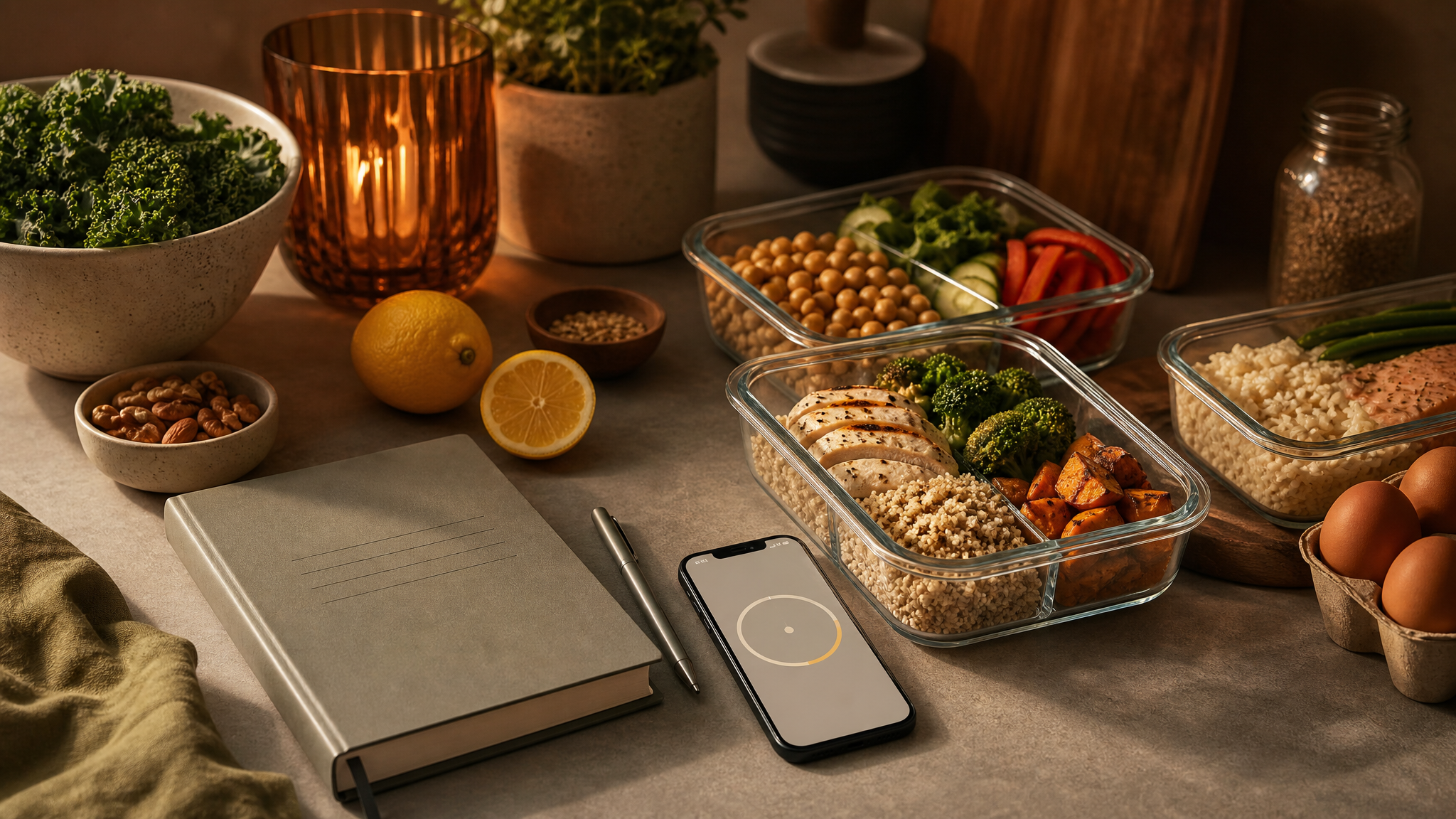
Most meal plans fail because they assume a fantasy version of your week.
Fantasy You has time to shop calmly, cook nightly, prep colorful containers, wash every dish, hit protein targets, avoid takeout, and never stand in front of the fridge eating shredded cheese like a raccoon with a mortgage.
Real You has meetings, errands, fatigue, family obligations, workouts, travel, and nights where the only thing standing between you and bad decisions is whether there is something edible already available.
That is why a minimum viable meal plan works better than a perfect one.
It is not a full nutrition overhaul. It is the smallest amount of structure that keeps your week from becoming random.
The Basics
|
|
| What it is |
A simplified meal-planning system built around default proteins, emergency meals, and repeatable shopping |
| Primary use |
Eating more consistently during busy weeks without relying on willpower every meal |
| Evidence level |
Moderate — supported by research on food environment, planning, protein satiety, and reduced decision load |
| Safety profile |
Generally safe; adapt for medical conditions, allergies, eating-disorder history, pregnancy, or clinician-guided diets |
| Best for |
Busy adults, inconsistent eaters, people rebuilding nutrition habits, and anyone tired of all-or-nothing meal prep |
Medical and Nutrition Disclaimer
This article is educational and not medical nutrition therapy. If you have diabetes, kidney disease, gastrointestinal disease, cardiovascular disease, food allergies, a history of eating disorders, pregnancy-related nutrition needs, or any condition requiring a specific diet, work with a qualified clinician or registered dietitian.
The Goal Is Fewer Bad Default Decisions
Nutrition does not usually fall apart because people do not know vegetables exist.
It falls apart because the default option at 7:30 p.m. is whatever is fastest, closest, and least annoying.
A minimum viable meal plan changes the default. It asks:
- What can I eat when I have no energy?
- What protein is always available?
- What meal can I assemble in five minutes?
- What grocery list can I repeat?
- What takeout choice is acceptable when cooking is not happening?
This is not glamorous. That is the point. Glamour is a terrible operating system.
The 3-Part Minimum Viable Meal Plan
You only need three components:
- Two default breakfasts or lunches.
- Three protein anchors.
- Two emergency meals.
That is enough to make the week dramatically less chaotic.
Part 1: Choose Two Default Meals
A default meal is something you can eat repeatedly without thinking much.
Examples:
| Meal |
Why it works |
| Greek yogurt + berries + granola |
Protein, fiber, fast assembly |
| Eggs + toast + fruit |
Simple, filling, flexible |
| Chicken rice bowl |
Easy to batch and customize |
| Turkey sandwich + carrots |
Cheap, portable, predictable |
| Protein smoothie + oats |
Useful when appetite or time is low |
| Tuna bowl + crackers + fruit |
Shelf-stable backup |
The default meal does not need to be perfect. It needs to be better than improvising from hunger.
Part 2: Build Around Protein Anchors
Protein is not magic, but it is highly practical. It supports muscle maintenance, satiety, and recovery, and many people under-build meals around it.
Choose three protein anchors for the week:
- rotisserie chicken,
- eggs,
- Greek yogurt,
- tofu or tempeh,
- canned tuna or salmon,
- lean ground beef or turkey,
- cottage cheese,
- beans and lentils,
- protein powder,
- pre-cooked chicken sausage,
- frozen edamame.
Then add easy carbohydrates, fats, and plants around them.
You are not designing a restaurant menu. You are creating enough structure that dinner does not require a debate.
Part 3: Define Emergency Meals
Emergency meals are for the nights when cooking is not realistic.
Good emergency meals are:
- fast,
- available,
- reasonably filling,
- not dependent on motivation,
- and better than the default chaos option.
Examples:
| Emergency meal |
Notes |
| Frozen stir-fry vegetables + microwave rice + chicken |
Fast, balanced, scalable |
| Burrito bowl from a restaurant |
Choose protein, beans, rice, salsa, vegetables |
| Omelet + toast |
Works when groceries are thin |
| Protein smoothie + peanut butter toast |
Better than skipping then overeating later |
| Bagged salad + rotisserie chicken |
Zero heroism required |
| Canned soup + extra protein + fruit |
Shelf-stable backup |
The win is not never ordering food. The win is knowing your acceptable fallback before you are tired.
The Repeatable Grocery List
Start with a base list you can reuse.
Protein
- Eggs
- Greek yogurt
- Rotisserie chicken or chicken breast
- Canned tuna/salmon or tofu
- Beans/lentils
Carbs
- Rice or microwave rice
- Oats
- Potatoes
- Whole-grain bread or tortillas
- Fruit
Plants
- Bagged salad
- Frozen vegetables
- Baby carrots
- Berries
- Salsa or pre-cut vegetables
Fats and flavor
- Olive oil
- Avocado
- Nuts
- Peanut butter
- Hummus
- Sauces you actually like
A boring list that gets used beats an ambitious list that rots.
How to Track Without Becoming Weird About It
If food tracking helps you, use it. If it makes you obsessive or miserable, do not turn nutrition into a surveillance project.
A minimum viable tracking system can be simple:
- Did I have protein at most meals?
- Did I eat at least one fruit or vegetable today?
- Did I avoid getting painfully hungry?
- Did I use my emergency meal instead of spiraling?
- Did I plan tomorrow’s first meal?
That is enough for many people to build consistency.
The "Chaotic Week" Version
When the week gets ugly, shrink the plan:
- Buy three protein options.
- Buy two ready-to-eat plant options.
- Buy one easy carb.
- Choose one acceptable takeout default.
- Decide breakfast for the next three days.
That is it.
A chaotic week is not the moment to prove your culinary identity. It is the moment to keep the floor from falling out.
Common Mistakes
Mistake 1: Planning meals you do not want to eat
If you hate the food, the plan is fiction.
Mistake 2: Ignoring cleanup
A meal that creates 45 minutes of dishes is not a weeknight default for most people.
Mistake 3: Optimizing dinner while breakfast is chaos
Fix the easiest repeatable meal first.
Mistake 4: Having no backup
If the plan only works under ideal conditions, it is decoration.
Mistake 5: Treating one takeout meal as failure
A planned fallback is different from an unplanned slide.
Sources and Further Reading
- U.S. Dietary Guidelines for Americans, 2020-2025.
- American College of Sports Medicine position stands on nutrition and exercise performance.
- Research reviews on dietary protein, satiety, and muscle protein synthesis.
- Studies on meal planning associations with diet quality and reduced obesity risk, including French NutriNet-Santé cohort analyses.
- Brian Wansink and broader food-environment research should be read carefully due to replication concerns, but the general principle that environment shapes food choice is supported across behavioral nutrition literature.
The HabitForge Takeaway
Better nutrition is not built from perfect weeks. It is built from fewer random meals, better defaults, and recovery plans for the nights when life punches through your calendar.
A minimum viable meal plan helps you become the kind of person who eats with structure even when the week is messy. That is the HabitForge lane: less performance, more repeatable identity.