The Basics
|
|
| What it is |
Using amber-tinted glasses or screen filters to block short-wavelength blue light (380-500 nm) that suppresses melatonin and disrupts circadian rhythm |
| Primary use |
Improving sleep quality and reducing sleep onset latency by preventing evening blue light from suppressing natural melatonin production |
| Evidence level |
Strong (for sleep/circadian effects); Limited (for eye damage prevention claims) |
| Safety profile |
Very Safe |
| Best for |
People with delayed sleep onset, irregular sleep schedules, or significant evening screen time who want to optimize circadian rhythm |
Key Facts at a Glance
- Blue light wavelengths around 480 nm suppress melatonin production by stimulating melanopsin-containing retinal ganglion cells
- Systematic reviews show amber-lens blue light blockers worn 2-3 hours before bed improve sleep quality and reduce sleep onset latency
- Clear "blue light blocking" lenses (filtering only 10-20% of blue light) are likely insufficient for meaningful circadian effects
- Claims that screen blue light causes permanent eye damage or macular degeneration are not supported by ophthalmology research
- Morning bright light exposure is equally important — it anchors circadian rhythm and makes evening melatonin production more robust
Blue light blocking glasses have gone from niche biohacker gear to mainstream wellness product in a few years. The pitch is simple: screens emit blue light, blue light wrecks your sleep and damages your eyes, so wear these glasses and you're protected. But like most wellness trends, the reality is more nuanced — and in some ways, more interesting — than the marketing suggests.
What Is Blue Light?
Blue light refers to the portion of the visible light spectrum with wavelengths between approximately 380 and 500 nanometers. It's high-energy visible (HEV) light, and it's found everywhere — not just in screens. Sunlight contains enormous amounts of blue light. LED and fluorescent bulbs do too. Your phone or laptop screen is actually a minor blue light source compared to a sunny afternoon outdoors.
This context matters, because it reframes the entire blue-light-blocking conversation.
The Sleep Connection — Where the Science Is Strong
The clearest and best-supported role for blue light blocking is circadian rhythm and sleep quality. Here's why:
The human circadian clock is entrained primarily by light — specifically short-wavelength (blue) light detected by specialized retinal cells called intrinsically photosensitive retinal ganglion cells (ipRGCs). These cells contain melanopsin and are exquisitely sensitive to blue light wavelengths around 480 nm. When stimulated, they suppress melatonin production via the suprachiasmatic nucleus and signal the brain that it's daytime.
This system evolved when the only blue light source at night was the moon and stars — effectively none. Exposing your eyes to bright blue light from phones, TVs, and overhead LEDs at 10 PM tells your circadian system it's still afternoon. Melatonin gets suppressed. Your sleep onset is delayed. Your sleep architecture — specifically slow-wave and REM sleep — suffers.
What the research shows: A 2021 systematic review found that amber-tinted blue light blocking glasses worn in the evening improved sleep quality, reduced sleep onset latency, and increased total sleep time compared to placebo (clear lens) conditions. The effect is real, particularly for people with irregular or late sleep schedules.
The Eye Strain and Damage Claims — Where the Science Is Weaker
The marketing often implies that blue light from screens causes permanent eye damage or macular degeneration. This is where skepticism is warranted.
The American Academy of Ophthalmology and most major ophthalmology bodies have stated there is no convincing evidence that everyday screen use at normal distances causes structural eye damage. The blue light levels from screens are orders of magnitude lower than what would be needed to cause phototoxicity.
Digital eye strain — the tiredness, dryness, and blurring many people experience after long screen sessions — is real, but research suggests it's primarily driven by reduced blinking (we blink 66% less when staring at screens), convergence fatigue, and accommodation demand, not blue light per se. Addressing these through the 20-20-20 rule (every 20 minutes, look at something 20 feet away for 20 seconds) and proper screen ergonomics is more evidence-based than any lens tint.
What Actually Works
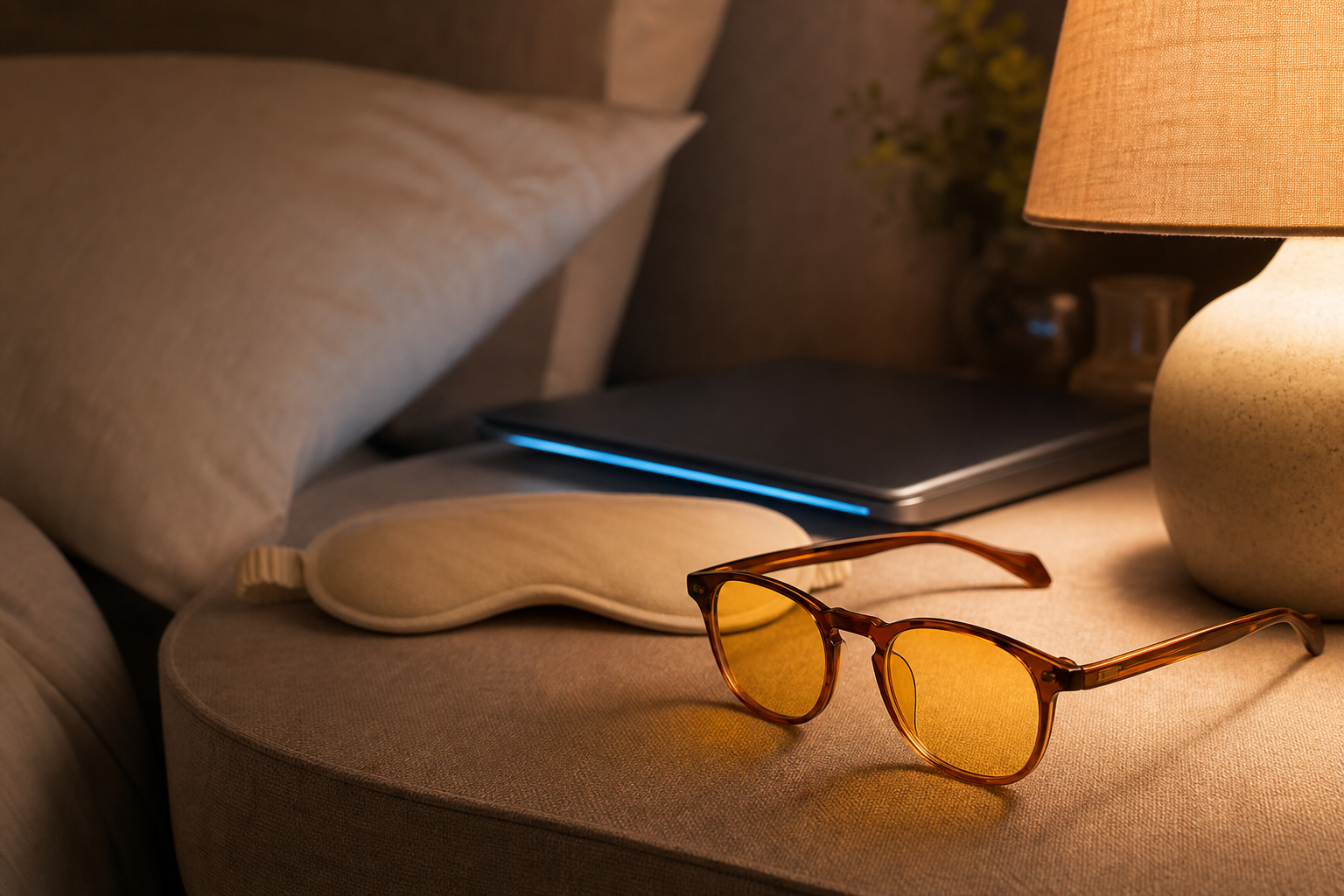
For sleep: The evidence supports blue light blocking glasses in the 2–3 hours before bed — particularly glasses with amber or orange lenses that block wavelengths below ~550 nm. Clear "blue light blocking" lenses, which filter only 10–20% of blue light, are likely insufficient for meaningful circadian effects. Alternatively, enabling night mode/warm display settings, dimming screen brightness, and switching to warm-toned lighting in the evening achieves similar results.
For eye comfort: Addressing ergonomics matters more than the lens tint. Ensure your screen is at arm's length, slightly below eye level. Take regular breaks. Use artificial tears if your eyes feel dry. Consider an anti-glare screen filter.
For comprehensive protection: The most impactful light-related habit for sleep isn't blocking blue light at night — it's getting bright light in the morning. Morning sunlight exposure (even 10–15 minutes outdoors) anchors your circadian rhythm earlier, making evening melatonin production more robust and natural sleep onset easier.
Practical Recommendations
- Wear amber-lens blue light blockers (not clear lenses) starting 2 hours before bed if you're on screens in the evening
- Enable night mode or warm display temperature after sunset on all devices
- Dim overhead lights in the evening — switch to warm bulbs or lamps
- Get outside within an hour of waking for morning light exposure; this is the most underrated circadian intervention
- Don't rely solely on glasses to compensate for poor sleep hygiene
Bottom Line
Blue light blocking is a legitimate tool for sleep — specifically the circadian suppression of melatonin in the evening hours. The eye damage narrative is largely overblown. Focus on the evening hours, use quality amber lenses if you choose glasses, and pair the strategy with morning light exposure for full circadian support.
What the Experts Say
Opinions below are paraphrased from each expert's public work, interviews, and podcasts — not direct quotes.
Andrew Huberman
Andrew Huberman is one of the most data-driven voices on light exposure and circadian biology. He strongly recommends avoiding bright artificial light — particularly overhead fluorescent and LED lighting — in the 2-3 hours before sleep, as it suppresses melatonin and delays circadian timing. He specifically advocates for amber/red-tinted glasses in the evening and dim, warm-toned lighting rather than overhead lights after sunset.
Paul Saladino
Paul Saladino views blue light exposure as one of the key modern deviations from ancestral living that disrupts circadian health. He recommends getting natural light during the day and blocking artificial blue light at night as part of an ancestral health practice, consistent with the body's natural light-dark cycle.
Dave Asprey
Dave Asprey has been an advocate for blue light blocking for years, making it a cornerstone of his sleep optimization protocol. He recommends blue light blocking glasses from sunset onwards and has discussed the mitochondrial and circadian impacts of evening blue light exposure. He prefers full-spectrum blue and green light blocking (not just the cosmetic amber tints) for genuine melatonin protection.
Joe Rogan
Joe Rogan has discussed blue light and sleep quality on the JRE, particularly after conversations with Matthew Walker and Andrew Huberman. He's incorporated blue light blocking practices into his evening routine and acknowledges the meaningful impact of phone and screen exposure on sleep onset.
Sources & Further Reading
- Effects of filtering blue light on sleep and circadian rhythm: A systematic review — Shechter et al., Sleep Medicine Reviews (2020) — https://pubmed.ncbi.nlm.nih.gov/31881567/
- Blue light has a dark side — Harvard Health Publishing, Harvard Medical School — https://www.health.harvard.edu/staying-healthy/blue-light-has-a-dark-side
- Are computer glasses worth it? — American Academy of Ophthalmology — https://www.aao.org/eye-health/tips-prevention/are-computer-glasses-worth-it
- Melanopsin-expressing intrinsically photosensitive retinal ganglion cells in circadian regulation — Lucas et al., Nature Reviews Neuroscience (2020) — https://pubmed.ncbi.nlm.nih.gov/32080423/
- The effect of blue-light blocking spectacle lenses on sleep quality: a systematic review — Lawrenson et al., Ophthalmic & Physiological Optics (2019) — https://pubmed.ncbi.nlm.nih.gov/30656668/
- Evening use of light-emitting eReaders negatively affects sleep, circadian timing, and next-morning alertness — Chang et al., PNAS (2015) — https://pubmed.ncbi.nlm.nih.gov/25535358/
Where to Buy / Find This