RecoveryMarch 21, 20264 min read
Blood Flow Restriction Training: Build Muscle With Less Weight
BFR training produces muscle hypertrophy at 20-30% of your one-rep max. Here's the science behind it and how to do it safely.
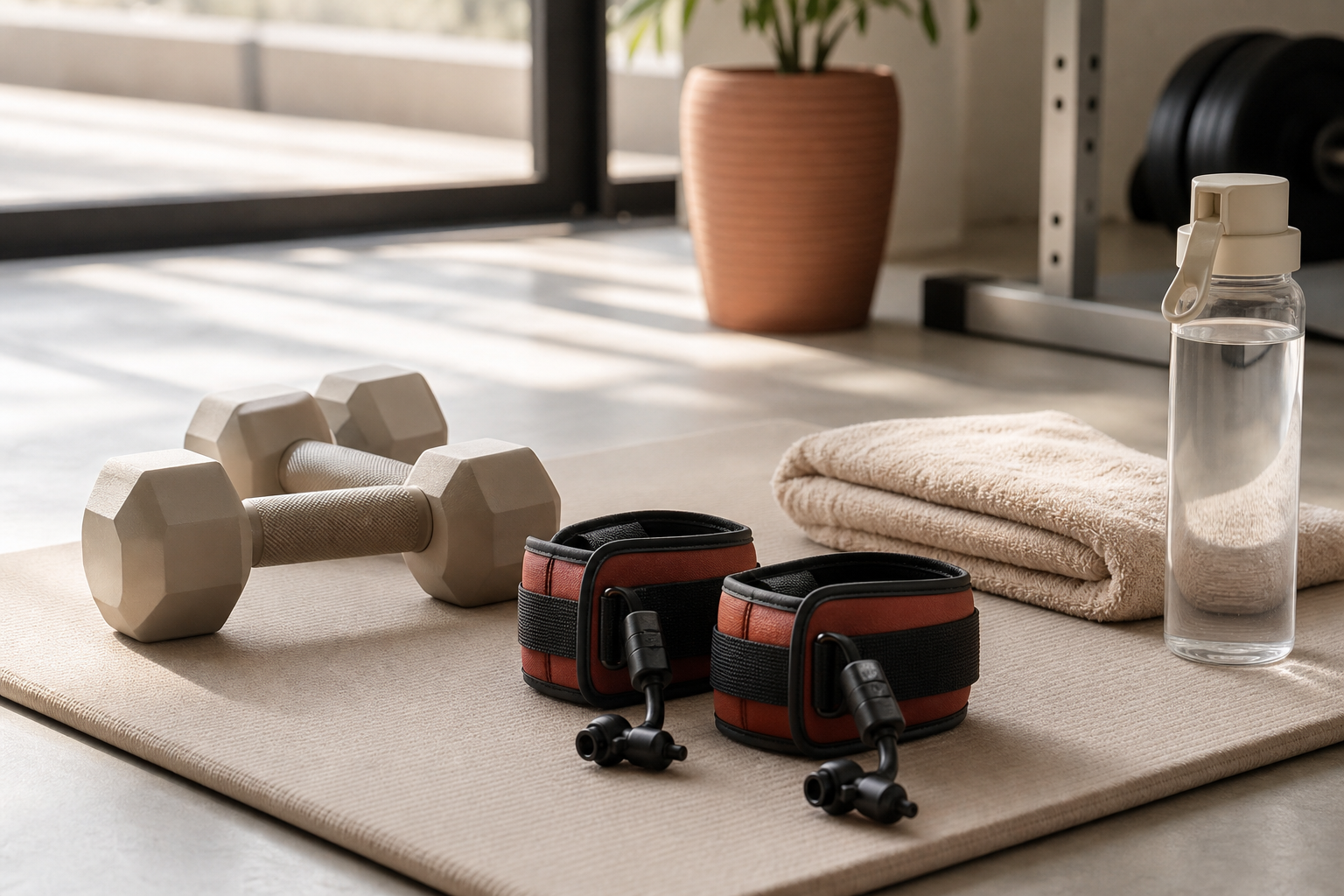
BFR training produces muscle hypertrophy at 20-30% of your one-rep max. Here's the science behind it and how to do it safely.
Building muscle typically requires lifting heavy — progressive overload, compound movements, working close to failure with significant loads. But what if you could achieve similar hypertrophy signaling with a fraction of the weight? Blood flow restriction (BFR) training makes exactly that claim, and the research backs it up.
BFR training, also called KAATSU training (its Japanese predecessor), involves applying a cuff or wrap to the proximal portion of a limb — upper arm for arms, upper thigh for legs — to partially restrict venous blood flow out of the muscle while maintaining arterial flow in. The limb then works in a state of relative hypoxia (low oxygen) and metabolic accumulation.
Exercises are performed at very low loads — typically 20–30% of one-rep maximum (1RM), compared to 65–85% 1RM for traditional hypertrophy training — for higher repetitions (15–30 per set), with short rest periods.
The partial occlusion creates a cascade of physiological responses that mimic high-intensity training:
Metabolite accumulation: Lactate, hydrogen ions, and other metabolic byproducts build up rapidly in the restricted limb. This metabolic stress is one of the primary drivers of hypertrophy — even without mechanical tension from heavy loads.
Fast-twitch fiber recruitment: As slow-twitch fibers fatigue quickly under hypoxic conditions, the nervous system recruits fast-twitch (Type II) muscle fibers earlier than it would at equivalent loads under normal conditions. Fast-twitch fibers have greater hypertrophic potential.
Hormonal response: BFR training elevates growth hormone (GH) significantly — some studies show acute GH responses comparable to or exceeding heavy resistance training. IGF-1 and other anabolic hormones also increase locally.
mTOR signaling: The combination of metabolic stress and mechanical tension (even at low loads) activates the mTOR pathway that drives muscle protein synthesis.
A 2019 meta-analysis published in the Journal of Orthopaedic & Sports Physical Therapy examined 19 studies and found that BFR training produces comparable muscle hypertrophy to traditional high-load resistance training, with significantly lower mechanical load on joints and connective tissue.
A landmark study at the University of Tokyo found that BFR at 20% 1RM produced similar muscle cross-sectional area gains to conventional training at 80% 1RM over 8 weeks in young men.
For strength gains, high-load training still has an edge — but for hypertrophy specifically, the evidence for equivalence is compelling.
Injured or post-surgical patients: BFR allows muscle maintenance and rebuilding with loads safe for healing tissue. It's now widely used in orthopedic rehabilitation — particularly post-ACL reconstruction and rotator cuff surgery.
Older adults: Age-related connective tissue fragility makes heavy loading progressively riskier. BFR enables hypertrophy training without the joint stress of conventional loads.
Athletes during deload weeks: Maintain muscle stimulus while reducing systemic fatigue and joint stress.
Anyone adding volume: BFR can be added to the end of conventional sessions for isolation work without adding significant recovery demands.
Cuff placement: Upper arm (proximal, below the shoulder) for arm exercises; upper thigh (proximal, below the hip) for leg exercises. Never apply to the neck, torso, or around joints.
Pressure: Aim for approximately 50–60% arterial occlusion pressure (AOP) for limbs — firm but not cutting off arterial flow. Purpose-built BFR cuffs with pressure gauges are recommended; elastic wraps work but lack pressure control.
Protocol structure:
Session frequency: 2–3x per week per muscle group; BFR sessions recover faster than heavy training.
Contraindications: Deep vein thrombosis history, severe cardiovascular disease, sickle cell disease, pregnancy, open wounds in the limb. Consult a healthcare provider if in doubt.
BFR training isn't a shortcut — it's a legitimate tool with strong mechanistic and clinical evidence. For anyone who needs to build or maintain muscle under load restrictions, or who wants to add low-fatigue hypertrophy volume to an existing program, it's one of the most underutilized techniques in mainstream fitness.
Put this into practice
Don’t just read about better habits. Build them into your day.
HabitForge turns ideas like this into a daily system with check-ins, reflection, and recovery cues that help you keep going when life gets messy.
Next step
Want to make this easier to do every day?
HabitForge turns these ideas into a calm daily system with check-ins, reflection, and recovery cues that help you keep momentum when life gets noisy.
See the appKeep reading
When a habit disappears for a few days, the useful question is not whether you failed. It is what the system revealed.
When a habit breaks, the goal is not to cosmetically preserve the streak. The goal is to practice returning.
A recovery version keeps a habit alive when the full version does not fit the day.